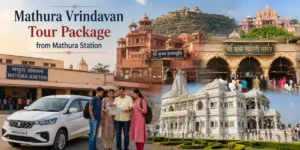
The Braj 84 Kosh Parikrama Yatra, also called the Braj Chaurasi Kos Yatra, is one of the most extensive pilgrimage journeys through Braj Bhoomi. The traditional circuit covers approximately 252 kilometres, representing 84 kos, and connects Mathura, Vrindavan, Gokul, Mahavan, Baldeo, Govardhan, Radha Kund, Barsana, Nandgaon and many other sacred places across the Braj region. The District Mathura administration describes the yatra as a 252-kilometre pilgrimage covering 12 forests, 24 gardens, 20 kunds and important Braj settlements.
For someone planning the yatra for the first time, the biggest question is not simply where to go. It is how to actually complete Braj 84 Kosh Parikrama in a practical and respectful way.
Traditionally, devotees undertake the journey on foot over an extended period. Today, organised vehicle-assisted yatras are also common, allowing pilgrims to cover the wider Braj circuit by road while undertaking walking parikramas at important sacred places. Current pilgrimage itineraries commonly range from about 5 to 12 days by vehicle, while a full walking journey can take several weeks depending on the pace and route.
I am Amit Deshwal from Ayodhya Varanasi Guides, and in this detailed guide I will explain how to do Braj 84 Kosh Parikrama, the complete route, important places, walking and vehicle options, number of days, approximate planning, best season, accommodation, preparation and practical tips.
The aim is to help you understand the difference between a genuine traditional 84 Kosh pilgrimage and a shorter Braj sightseeing tour that only covers a few famous temples.
Content Highlights
ToggleWhat Exactly Is Braj 84 Kosh Parikrama?
Braj 84 Kosh Parikrama is a traditional circumambulation of the wider Braj Mandal, the sacred geographical region associated with the devotional traditions surrounding Shri Krishna and Radha Rani.
The commonly accepted distance is around 252 kilometres, or 84 kos. The District Mathura administration officially describes the Braj Chaurasi Kos Yatra as a 252-kilometre journey and lists Mathura, Vrindavan, Govardhan, Barsana, Nandgaon, Gokul, Mahavan and Baldeo among its major places.
The important thing to understand is that this is not simply:
Mathura → Vrindavan → Govardhan → Barsana → Mathura.
The wider Braj circuit reaches numerous smaller villages, forests, kunds, sarovars and sacred locations.
This is what makes the complete yatra different from a normal Mathura-Vrindavan holiday.
Braj 84 Kosh Yatra at a Glance
| Particular | Information |
|---|---|
| Traditional name | Braj Chaurasi Kos Yatra |
| Common distance | Approximately 252 km |
| Traditional unit | 84 Kos |
| Region | Braj Mandal |
| Major centres | Mathura, Vrindavan, Gokul, Govardhan, Barsana, Nandgaon, Baldeo |
| Traditional method | Walking |
| Modern method | Vehicle-assisted pilgrimage |
| Typical vehicle-assisted duration | Around 5–12 days |
| Traditional walking duration | Several weeks |
| Nature | Pilgrimage and parikrama |
The exact sequence can vary between traditional groups and route plans. Even current sources describe local route variations, so pilgrims following the complete circuit should confirm the route with their particular yatra group or an experienced local guide.
What Does 84 Kosh Mean?
The expression Chaurasi Kos literally refers to 84 kos.
A kos is an old Indian unit of distance, commonly approximated at around three kilometres in descriptions of this pilgrimage. Therefore:
84 Kos × approximately 3 km = approximately 252 km
The 252-kilometre figure is the commonly accepted measurement of the Braj Chaurasi Kos pilgrimage, and it is also the distance given by the District Mathura administration.
However, do not expect every modern map or tour operator\’s route to show exactly the same road distance.
There are several reasons:
- Traditional pilgrimage paths do not always follow modern roads.
- Some sacred places require detours.
- Different groups may include different subsidiary sites.
- Vehicle routes can be longer than the traditional walking route.
- Local sightseeing may add additional kilometres.
Therefore, 252 km should be understood as the traditional pilgrimage measure rather than a promise that your vehicle\’s odometer will show exactly 252 km.
Is Braj 84 Kosh the Same as Govardhan Parikrama?
No.
This is one of the most common misunderstandings among first-time visitors.
Braj 84 Kosh Parikrama is the much larger circuit around the wider Braj Mandal.
Govardhan Parikrama is a separate approximately 21-kilometre circuit around Govardhan. The District Mathura administration lists it as 21 km or 7 kos.
Similarly, Vrindavan Parikrama is a separate local pilgrimage. The District Mathura administration lists its length as approximately 15 km.
| Parikrama | Approximate Distance |
|---|---|
| Braj Chaurasi Kos | 252 km |
| Govardhan Parikrama | 21 km |
| Vrindavan Parikrama | 15 km |
| Gokul Parikrama | 10 km |
| Barsana Parikrama | 4 km |
| Baldeo Parikrama | 5 km |
| Kokilavan Parikrama | 3 km |
These smaller parikramas can form part of a wider Braj pilgrimage, but they are not substitutes for the complete 84 Kosh circuit. The official Mathura district page lists these individual parikramas separately.
How Many Days Does Braj 84 Kosh Parikrama Take?
There is no single answer because the duration depends on how you travel.
If you are undertaking the complete pilgrimage on foot, you need substantially more time than someone travelling between locations by car.
Current pilgrimage guides commonly describe traditional walking journeys as lasting several weeks, while vehicle-assisted itineraries can be completed in roughly 5–12 days depending on how comprehensive the route is.
The Mathura district administration itself describes the Braj Chaurasi Kos Yatra as a seven-day journey in its official pilgrimage information.
Which Duration Should You Choose?
| Duration | Best For | Coverage |
|---|---|---|
| 5 Days | Limited holidays | Major Braj centres |
| 7 Days | First-time pilgrims | Broad vehicle-assisted circuit |
| 10 Days | Detailed pilgrimage | More sacred sites and walking |
| 15+ Days | Slow pilgrimage | Extensive route exploration |
| Several Weeks | Traditional walking | Full walking experience |
If your objective is to understand and experience the wider Braj circuit rather than simply visit the most famous temples, 7 to 10 days is a more comfortable modern vehicle-assisted format.
Should You Walk the Entire 84 Kosh Route?
The answer depends on the type of pilgrimage you want.
Traditional Walking Yatra
Walking is the traditional form of undertaking a parikrama.
A walking pilgrimage gives you the opportunity to move slowly through the countryside, villages, forests and sacred locations rather than simply travelling between major towns.
It can be appropriate for devotees who:
- Have sufficient time
- Are physically prepared for extended walking
- Prefer a traditional pilgrimage experience
- Are comfortable with simple accommodation
- Are travelling with an organised yatra group
However, walking around 252 km is a substantial physical undertaking.
It should not be approached as a casual sightseeing activity.
Vehicle-Assisted Yatra
A vehicle-assisted yatra is more practical for many modern travellers.
The vehicle takes you between the wider Braj destinations while you can undertake selected walking parikramas at places such as Govardhan, Vrindavan, Gokul or Barsana.
This can be especially useful for:
- Families
- Senior travellers
- Children
- Travellers with limited holidays
- First-time visitors
- Pilgrims who prefer comfortable accommodation
The important distinction is that a vehicle-assisted 84 Kosh Yatra is not the same thing as walking all 252 km.
It is a road-supported pilgrimage through the traditional Braj circuit.
What Is the Traditional Braj 84 Kosh Route?
There is no single modern road route that perfectly represents every traditional version of the Braj Chaurasi Kos circuit.
The broad pilgrimage landscape includes:
Mathura → Gokul/Mahavan → Baldeo → Vrindavan → Govardhan/Radha Kund → Barsana → Nandgaon → outer Braj forests and sacred villages → return towards Mathura/Vrindavan
The precise sequence varies.
Some routes extend towards Kamyavan, Deeg and other outer Braj areas, while organised groups may divide the journey differently. Current pilgrimage sources specifically identify Mathura, Vrindavan, Gokul, Mahavan, Baldeo, Nandgaon, Barsana, Govardhan, Radha Kund and Kamyavan among the principal areas.
This is why it is better to think of the yatra as a large sacred circuit rather than one fixed highway route.
Major Braj 84 Kosh Yatra Route and Places
1. Mathura
Mathura is one of the natural starting points for a Braj pilgrimage.
Important places include:
- Shri Krishna Janmabhoomi
- Dwarkadhish Temple
- Vishram Ghat
- Yamuna River
- Bhuteshwar Mahadev
- Vishram Ghat area
A traditional pilgrimage may begin from Mathura, particularly around the Vishram Ghat area.
The District Mathura administration identifies Mathura as one of the principal places on the Braj Chaurasi Kos circuit.
2. Gokul and Mahavan
Gokul represents an important part of the Braj pilgrimage landscape connected with Krishna\’s childhood.
Places commonly visited include:
- Raman Reti
- Brahmand Ghat
- Gokul
- Mahavan
- Chaurasi Khamba
- Gokul temples
- Yamuna-side sacred sites
The official Mathura district information lists Gokul Parikrama as approximately 10 km and describes Gokul as a major pilgrimage location.
3. Baldeo
Baldeo, also known as Dauji, is associated with Lord Balarama.
The main attraction is:
- Dauji Temple
Baldeo also has a local parikrama of approximately 5 km according to the District Mathura administration.
It can be incorporated into a wider Braj route rather than treated simply as a quick temple stop.
4. Vrindavan
Vrindavan is one of the most important centres of the Braj pilgrimage.
Major places include:
- Banke Bihari Temple in Vrindavan
- Radha Raman Temple
- Radha Vallabh Temple
- Madan Mohan Temple
- ISKCON Temple
- Nidhivan
- Seva Kunj
- Keshi Ghat
- Prem Mandir in Vrindavan
The official district information lists Vrindavan Parikrama at approximately 15 km.
If you have time, walking the local Vrindavan Parikrama gives you a very different experience from simply visiting the temples by car.
5. Govardhan
Govardhan is one of the most important sections of the entire Braj pilgrimage.
Major places include:
- Govardhan Hill
- Daan Ghati
- Mansi Ganga
- Jatipura
- Govind Kund
- Kusum Sarovar
- Radha Kund
- Shyam Kund
The official Mathura administration lists Govardhan Parikrama as approximately 21 km.
If you are physically prepared, this is one of the most meaningful walking sections to include in a vehicle-assisted Braj yatra.
6. Radha Kund and Shyam Kund
Radha Kund and Shyam Kund are important pilgrimage sites near Govardhan.
Many pilgrims deliberately spend additional time here rather than treating them as a quick sightseeing stop.
The atmosphere is quite different from the larger tourist centres, so respectful behaviour and a slower pace are appropriate.
7. Barsana
Barsana is traditionally associated with Radha Rani.
Major places include:
- Shri Radha Rani Temple
- Maan Mandir
- Lalita Sakhi Temple
- Mor Kutir
- Priya Kund
- Sankari Khor
- Barsana Parikrama area
The official Mathura district information lists Barsana Parikrama at approximately 4 km.
Barsana is particularly crowded during major festival periods, so plan extra time if travelling around Holi or other major religious occasions.
8. Nandgaon
Nandgaon is associated with Nand Baba and Krishna\’s childhood traditions.
Important places include:
- Nand Bhawan
- Nandgaon Parikrama area
- Pawan Sarovar
- Yashoda Kund
- Charan Pahadi
Nandgaon is naturally paired with Barsana in many pilgrimage itineraries because the two towns are closely connected in Braj devotional tradition.
9. Kokilavan and Outer Braj
The wider 84 Kosh pilgrimage goes beyond the famous Mathura-Vrindavan-Govardhan triangle.
Other sacred areas include:
- Kokilavan
- Kosi
- Kamyavan
- Bahulavan
- Talvan
- Kumudvan
- Lohvan
- Other forests and kunds
The official Mathura district page includes Kokilavan among the individual Braj parikramas and lists its local circuit at approximately 3 km.
This outer section is one reason why a complete Braj yatra cannot realistically be reduced to a conventional two- or three-day Mathura-Vrindavan tour.
How to Do Braj 84 Kosh Parikrama in 7 Days
For many travellers, seven days offers a useful balance between coverage and comfort.
Day 1: Mathura
Start your pilgrimage in Mathura.
Visit:
- Shri Krishna Janmabhoomi
- Dwarkadhish Temple
- Vishram Ghat
- Yamuna-side temples
- Bhuteshwar Mahadev
If possible, begin the pilgrimage with darshan and prayers before proceeding to the next section.
Overnight: Mathura
Day 2: Gokul, Mahavan and Baldeo
Start early.
Visit:
- Gokul
- Raman Reti
- Brahmand Ghat
- Mahavan
- Chaurasi Khamba
- Baldeo
- Dauji Temple
If your group is comfortable, include a portion of the local Gokul or Baldeo parikrama.
Overnight: Mathura or Vrindavan
Day 3: Vrindavan
Spend the majority of the day in Vrindavan.
Visit:
- Banke Bihari Temple
- Radha Raman Temple
- ISKCON Temple
- Madan Mohan Temple
- Nidhivan
- Seva Kunj
- Keshi Ghat
- Prem Mandir
If you want to perform Vrindavan Parikrama, reserve sufficient time rather than trying to squeeze it between multiple temple visits.
Overnight: Vrindavan
Day 4: Govardhan and Radha Kund
Start early.
Visit:
- Daan Ghati
- Govardhan Hill
- Mansi Ganga
- Jatipura
- Kusum Sarovar
- Radha Kund
- Shyam Kund
Those who are physically prepared can undertake the full approximately 21-km Govardhan Parikrama.
Others can choose selected walking sections while using the vehicle for the remaining route.
Overnight: Govardhan or Vrindavan
Day 5: Barsana and Nandgaon
Proceed towards Barsana.
Visit:
- Shri Radha Rani Temple
- Maan Mandir
- Lalita Sakhi Temple
- Priya Kund
- Mor Kutir
Then proceed towards Nandgaon.
Visit:
- Nand Bhawan
- Pawan Sarovar
- Yashoda Kund
- Charan Pahadi
Overnight: Vrindavan or nearby accommodation
Day 6: Kamyavan and Outer Braj
Use this day for the less frequently visited sections.
Depending on your exact route, visit:
- Kamyavan
- Kokilavan
- Kosi
- Bahulavan
- Talvan
- Kumudvan
- Other sacred kunds and forests
This is where a knowledgeable local route planner becomes valuable because these locations are not all arranged like a conventional tourist circuit.
Overnight: As per route
Day 7: Remaining Braj Circuit and Completion
Use the final day to complete remaining sections of your selected 84 Kosh route.
Depending on the starting point and route variation, this may include:
- Remaining forests
- Sacred kunds
- Smaller temples
- Villages
- Final darshan
- Return towards Mathura or Vrindavan
The yatra is traditionally a circuit, so the final stage should bring you back towards your starting point.
How to Do Braj 84 Kosh Parikrama in 10 Days
If you have ten days, you do not need to rush.
A slower itinerary can look like this:
| Day | Main Area |
|---|---|
| Day 1 | Mathura |
| Day 2 | Gokul + Mahavan |
| Day 3 | Baldeo + surrounding sites |
| Day 4 | Vrindavan temples |
| Day 5 | Vrindavan Parikrama + sacred ghats |
| Day 6 | Govardhan |
| Day 7 | Govardhan Parikrama + Radha Kund |
| Day 8 | Barsana |
| Day 9 | Nandgaon + Kokilavan |
| Day 10 | Kamyavan + remaining Braj sites |
This format provides more time for darshan, walking and rest.
It is particularly suitable for families who do not want to change hotels every night.
What About a Traditional Walking Yatra?
If you specifically want to perform the complete 84 Kosh Parikrama on foot, you should plan it as a dedicated pilgrimage rather than simply extending a normal holiday.
A traditional walking itinerary needs:
- A detailed route map
- Daily walking targets
- Rest days or lighter days
- Accommodation arrangements
- Food and water planning
- Luggage arrangements
- Medical and emergency planning
- Local route knowledge
- Appropriate seasonal timing
Some organised traditional yatras may also provide support vehicles, meals or group accommodation.
The walking duration can vary considerably. Current pilgrimage sources describe traditional walking versions as taking several weeks, while some organised groups complete the route faster depending on their daily schedule.
Therefore, do not assume that a single fixed number of days applies to every walking yatra.
How Much Walking Is Involved?
That depends on your chosen format.
| Yatra Type | Walking Requirement |
|---|---|
| Complete traditional yatra | Extensive |
| 15-day assisted yatra | Moderate to extensive |
| 10-day vehicle-assisted | Selected parikramas |
| 7-day vehicle-assisted | Limited/selected walking |
| 5-day tour | Mostly vehicle-based |
If you are travelling with older family members, a vehicle-assisted format with selected parikramas is usually more manageable than attempting to walk the entire circuit.
What Is the Best Time for Braj 84 Kosh Parikrama?
Weather can make a major difference because much of the pilgrimage involves outdoor travel.
The most comfortable period is generally the cooler part of the year.
October to March
This is generally the easiest period for long walks and outdoor sightseeing.
However, major festivals can bring very large crowds.
March
March can be spiritually attractive because of Holi celebrations in Braj, but it is also one of the busiest periods.
If you travel during Holi, expect:
- Heavy crowds
- Traffic restrictions
- Increased hotel demand
- Longer temple queues
- More difficult vehicle movement
April to June
These months can become very hot.
For a long walking pilgrimage, summer heat can make the journey significantly more demanding.
July to September
The monsoon season changes the walking conditions and road experience.
The District Mathura administration specifically lists Chaturmas and Adhik Maas among periods associated with the Braj Chaurasi Kos pilgrimage.
If you are choosing dates for religious reasons rather than purely for weather, discuss the intended route and arrangements with your yatra organiser before finalising the schedule.
What Is the Best Starting Point?
There are two common practical choices:
Mathura
Starting from Mathura makes sense because it is a major railway and road gateway and is strongly associated with the beginning of the Braj pilgrimage.
Vishram Ghat is a particularly important pilgrimage point.
Vrindavan
Some groups and travellers begin from Vrindavan because of its importance as the devotional heart of Braj.
The choice depends on:
- Your arrival station
- Hotel location
- Traditional group route
- Your selected operator
- Whether you want Mathura or Vrindavan as your first major darshan
Because the circuit is circular, the key principle is to complete the circuit according to the route you have selected, rather than focusing too much on one universally correct starting point.
Where Should You Stay During the Yatra?
Accommodation depends heavily on whether you are doing the route independently or as an organised pilgrimage.
Mathura
Good for:
- Arrival
- First-night stay
- Mathura sightseeing
- Gokul access
Vrindavan
Good for:
- Multiple-night stays
- Major temple visits
- Vrindavan Parikrama
- Access to several western Braj destinations
Govardhan
Useful if you want to perform Govardhan Parikrama without rushing.
Barsana/Nandgaon Area
Useful for a slower western Braj itinerary, although accommodation choices can be more limited than in Mathura or Vrindavan.
For families, always consider:
- Clean bathrooms
- Lift access
- Vehicle accessibility
- Restaurant availability
- Distance from major temples
- Quiet rooms
- Availability of hot water
During major festivals, book well in advance.
What Food Should You Expect?
Braj has many vegetarian food options.
You can generally find:
- Roti
- Dal
- Sabzi
- Rice
- Khichdi
- Kachori
- Lassi
- Sweets
- Simple vegetarian thalis
During a long pilgrimage, simple meals are often easier to manage than heavy restaurant food.
If you are undertaking extended walking, carry drinking water and take regular breaks.
What Should You Pack for Braj 84 Kosh Yatra?
Packing depends on whether you are walking or travelling by vehicle.
Basic Items
- Comfortable clothing
- Walking footwear
- Light day bag
- Water bottle
- Sun protection
- Personal identification
- Personal medicines
- Basic toiletries
- Phone
- Power bank
- Small amount of cash
For Winter
Add:
- Light jacket
- Shawl
- Warm socks
- Additional layers for early mornings
For Long Walking Sections
Keep your day bag as light as possible.
Your main luggage can remain in your accommodation or support vehicle when the route arrangement allows it.
Important Practical Tips for First-Time Pilgrims
1. Do Not Rush
The biggest mistake is trying to treat the 84 Kosh Yatra as a checklist.
Braj has hundreds of sacred locations and you will enjoy the experience more if you allow enough time for darshan and rest.
2. Keep Extra Time for Temples
Temple crowds can change quickly, especially on weekends and religious occasions.
3. Plan Walking Separately
Do not assume that a car can take you directly to every temple.
Several sacred locations are located inside narrow lanes or pedestrian areas.
4. Keep Your Route Flexible
Traffic, local events and temple schedules can affect your plan.
5. Confirm the Exact Package
If booking a tour, ask:
- Which Braj locations are included?
- Is the route actually the 84 Kosh circuit?
- How many kilometres are covered by vehicle?
- Which parikramas are walked?
- Are meals included?
- Are hotels included?
- Is a local guide included?
- Are tolls and parking included?
6. Do Not Confuse a 5-Day Tour With a Full Walking Yatra
A five-day vehicle tour can cover major parts of Braj, but it should not be advertised as five days of walking the complete 252-km route.
This distinction is important when comparing packages.
Braj 84 Kosh Yatra: Walking vs Vehicle
| Factor | Complete Walking Yatra | Vehicle-Assisted Yatra |
|---|---|---|
| Distance | Approximately 252 km on foot | Wider route by road |
| Duration | Several weeks | Around 5–12 days |
| Physical demand | Very high | Moderate |
| Best for | Dedicated pilgrims | Families and time-limited travellers |
| Accommodation | May be simple | Hotels/guest houses |
| Flexibility | Lower | Higher |
| Local sightseeing | Slow and immersive | Faster |
| Parikrama experience | Extensive | Selected sections |
The best option depends on what you want from the pilgrimage.
If the objective is traditional immersion, walking has a special character.
If the objective is to cover the wider Braj region comfortably within a limited holiday, vehicle assistance is more practical.
Should You Book a Braj 84 Kosh Yatra Package?
For a multi-day route covering numerous towns, villages and sacred sites, organised travel can simplify the experience.
A well-planned package may arrange:
- Private vehicle
- Hotels
- Driver
- Daily itinerary
- Local sightseeing
- Route planning
- Temple visits
- Meals, depending on package
- Pickup and drop
For families and senior travellers, this can be particularly convenient.
However, do not choose a package only because it uses the words “84 Kosh.”
Ask the operator for the actual route.
A package that covers only Mathura, Vrindavan, Govardhan, Barsana and Nandgaon may provide a good Braj tour, but it is not necessarily equivalent to the complete traditional circuit.
How Much Does Braj 84 Kosh Yatra Cost?
There is no single fixed price because the cost depends on the travel style.
Main Cost Factors
| Expense | What Affects It |
|---|---|
| Hotels | Room category and location |
| Vehicle | Sedan, SUV, Innova, Tempo Traveller |
| Duration | Number of days |
| Food | Included or separate |
| Guide | Included or separate |
| Festival season | Demand and availability |
| Group size | Vehicle sharing |
| Walking support | Luggage/support arrangements |
For this reason, it is better to request a detailed quotation based on your dates and group size rather than relying on one generic “84 Kosh package price.”
How to Choose a Reliable Braj 84 Kosh Yatra Operator
Before booking, ask for a written itinerary.
It should clearly state:
- Starting point
- Ending point
- Number of days
- Daily route
- Places covered
- Hotel names or categories
- Vehicle type
- Meal inclusions
- Driver charges
- Toll and parking inclusions
- Walking parikrama arrangements
- Cancellation terms
Most importantly, ask whether the package covers the complete Braj circuit or only the major tourist destinations.
A transparent itinerary makes comparison much easier.
Why Plan Braj 84 Kosh Yatra With Vrindavan Travels?
The Braj circuit is considerably larger than a normal Mathura-Vrindavan sightseeing itinerary.
At Vrindavan Travels, the journey can be planned according to your available days, group size, hotel preference and preferred amount of walking.
For example, a family with senior citizens may prefer a vehicle-assisted itinerary with comfortable hotels and selected walking parikramas.
A group of younger pilgrims with more time may prefer a longer itinerary with additional sacred forests, kunds and walking sections.
The important thing is to build the itinerary around the traveller rather than forcing every group into the same schedule.
Book Vrindavan Tour Packages
Choosing the right Vrindavan tour package comes down to how many days you have and how much of Braj you want to cover beyond the main temples.
- Same Day Mathura Vrindavan Tour Package — Banke Bihari, Prem Mandir and Krishna Janmabhoomi in one day
- 2 Days Mathura Vrindavan Tour Package — adds an early morning darshan and Govardhan
- 3 Days Mathura Vrindavan Tour Package from Bangalore — built around Delhi flight arrivals
- 4 Days Mathura Vrindavan Tour Package from Delhi — covers Gokul, Govardhan and Barsana unhurried
- 5 Days Mathura Vrindavan Tour Package — full Braj circuit with Govardhan Parikrama
Book earlier than you think you need to, especially October to March or near Holi and Janmashtami, since rooms close to Banke Bihari fill months ahead.
For customised itineraries and private transportation, browse our Mathura Vrindavan tour packages on +91 70786 55073.
Final Thoughts
The Braj 84 Kosh Parikrama Yatra is one of the most extensive ways to experience Braj Bhoomi.
Its approximately 252-kilometre traditional circuit connects the major pilgrimage centres of Mathura, Vrindavan, Gokul, Mahavan, Baldeo, Govardhan, Radha Kund, Barsana and Nandgaon with numerous smaller sacred locations. The official Mathura district information also identifies 12 forests, 24 gardens and 20 kunds within its description of the pilgrimage.
If you have several weeks and are prepared for extensive walking, a traditional walking yatra can provide a slow and immersive pilgrimage experience.
If you have only a week or so, a vehicle-assisted 84 Kosh Yatra can allow you to cover the wider Braj circuit while still performing meaningful walking parikramas at Govardhan, Vrindavan, Gokul and other important locations.
The most important thing is to understand exactly what type of yatra you are booking.
252 kilometres on a traditional walking route and a 7-day vehicle-assisted Braj tour are two different experiences.
Plan your route carefully, leave enough time for darshan and rest, and avoid trying to turn the pilgrimage into a race.
Braj is best experienced with patience, respect and devotion.
Frequently Asked Questions
1. What is Braj 84 Kosh Parikrama Yatra?
Braj 84 Kosh Parikrama is a traditional pilgrimage around the wider Braj Mandal. The commonly accepted distance is approximately 252 kilometres, or 84 kos. The route includes Mathura, Vrindavan, Gokul, Mahavan, Baldeo, Govardhan, Barsana, Nandgaon and numerous other sacred places.
2. How many kilometres is the complete Braj 84 Kosh Parikrama?
The traditional measurement is approximately 252 kilometres. Actual road distance can differ because modern vehicles follow roads and may need to make additional detours to reach temples and villages.
3. How many days does Braj 84 Kosh Yatra take?
A traditional walking pilgrimage generally requires several weeks, while a vehicle-assisted journey can be planned in around 5–12 days depending on how comprehensive the route is. The District Mathura administration describes the Chaurasi Kos Yatra as a seven-day journey.
4. Can I complete Braj 84 Kosh Yatra by car?
Yes. A vehicle-assisted pilgrimage is a practical way to cover the wider Braj region. However, travelling by car does not mean that you have walked the complete 252-km traditional circuit. Selected walking parikramas can be included along the route.
5. What is the difference between Braj 84 Kosh and Govardhan Parikrama?
Braj 84 Kosh is the much larger circuit around Braj Mandal. Govardhan Parikrama is a separate approximately 21-km circuit around Govardhan. The two can be combined during a Braj pilgrimage.
6. Is Vrindavan Parikrama part of Braj 84 Kosh?
Vrindavan is part of the wider Braj pilgrimage landscape, and devotees may perform Vrindavan Parikrama during their Braj yatra. However, Vrindavan Parikrama itself is a separate local circuit, listed at approximately 15 km by the District Mathura administration.
7. Which places are most important on the 84 Kosh route?
Major places include Mathura, Vrindavan, Gokul, Mahavan, Baldeo, Govardhan, Radha Kund, Barsana and Nandgaon. The wider pilgrimage also includes forests, kunds and smaller villages such as Kokilavan and areas around Kamyavan.
8. Where should Braj 84 Kosh Parikrama start?
Mathura and Vrindavan are both practical starting points depending on your route and pilgrimage tradition. Mathura, particularly the Vishram Ghat area, is a common starting reference, while some groups begin from Vrindavan. Since the pilgrimage is circular, the important point is to follow and complete the selected circuit.
9. Can senior citizens do Braj 84 Kosh Yatra?
Yes, but the format should be adapted to their comfort. A vehicle-assisted itinerary with comfortable accommodation, regular rest breaks and shorter walking sections is generally more manageable than attempting the entire route on foot.
10. Is it necessary to walk barefoot during Braj 84 Kosh Parikrama?
Practices can vary between pilgrims and traditions. Do not assume that every traveller must follow exactly the same walking practice. If you are joining a traditional group, follow the group\’s established customs and practical guidance.
11. What is the best time to do Braj 84 Kosh Yatra?
The cooler months are generally more comfortable for extensive outdoor travel and walking. October to March is a practical period for many travellers, although festivals can create very large crowds. The appropriate timing may also depend on the religious calendar and the particular yatra tradition.
12. Can Braj 84 Kosh Yatra be completed in seven days?
Yes, a seven-day vehicle-assisted pilgrimage can cover a broad section of the Braj circuit. The District Mathura administration itself describes the Braj Chaurasi Kos Yatra as a seven-day journey. However, a seven-day vehicle itinerary should not be confused with walking the entire 252 kilometres.
13. What should I carry for the Braj 84 Kosh Yatra?
Carry comfortable clothing, suitable walking footwear, water, sun protection, identification, personal medicines, toiletries, a phone, power bank and a small amount of cash. If you will be walking long distances, keep your day bag light.
14. How can I know whether a tour package is actually covering the 84 Kosh route?
Ask for the complete day-wise route before booking. Check whether the itinerary includes the wider Braj circuit or only popular destinations such as Mathura, Vrindavan, Govardhan, Barsana and Nandgaon. Also ask which sections are travelled by vehicle and which are walked.
15. Should I do Braj 84 Kosh Parikrama independently or with a tour operator?
Independent travel gives you more flexibility, but the wider circuit involves many villages, forests, kunds and smaller pilgrimage locations that can make route planning complicated. An experienced pilgrimage operator can simplify transportation, accommodation and daily scheduling. For a traditional walking yatra, joining an established group can also make the logistics easier.
Contact now
Vrindavan Travels
Contact+917078655073
Email us at info@vrindavantravels.com